> For the complete documentation index, see [llms.txt](https://docs.wafra.sa/llms.txt). Markdown versions of documentation pages are available by appending `.md` to page URLs; this page is available as [Markdown](https://docs.wafra.sa/crm/activity-types.md).
# Activity Types
### Activity Types
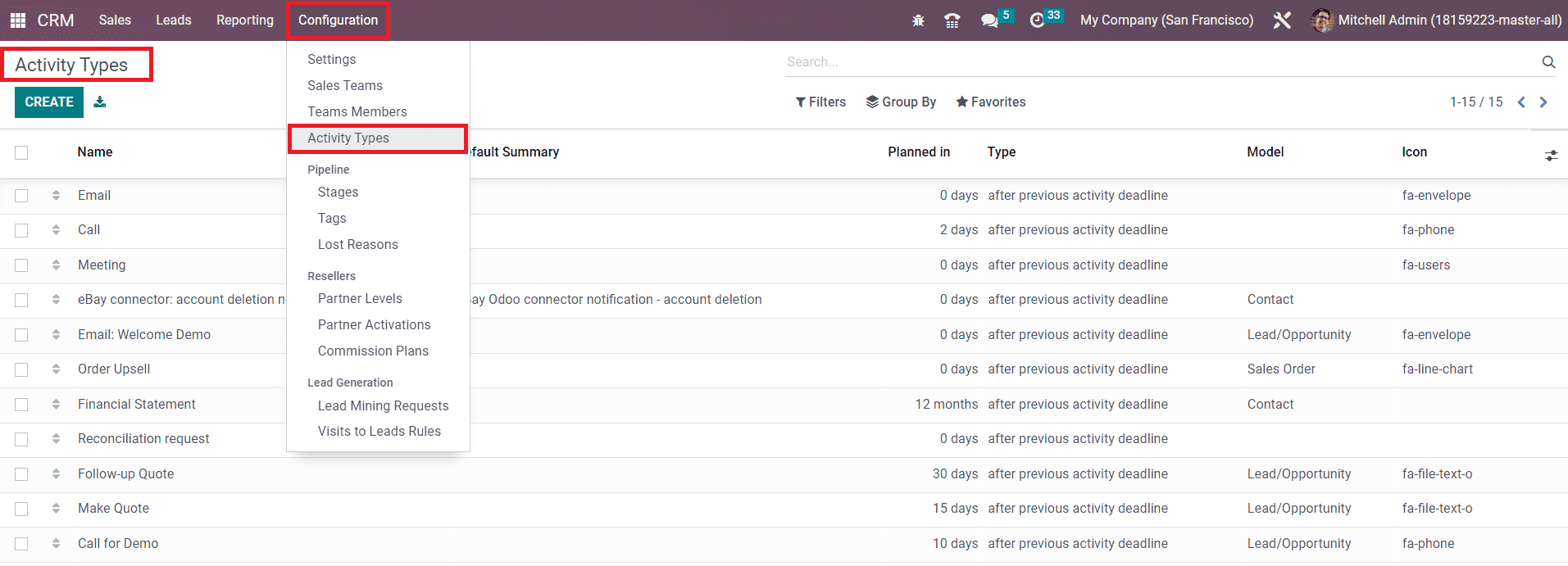
In order to take a lead to the next level of operation, it is essential to keep in touch with the concerned customers regularly. Odoo allows you to schedule various activities with the customer with the help of the schedule activity feature. This feature is available in almost all sales-related and customer management modules in Odoo. Using this feature, you can connect with your customers through scheduled programs. Configuring different types of activities in Odoo 16 is an easy task now. You can find the **Activity Types** option in the **Configuration** menu which will help you to create new activity types.
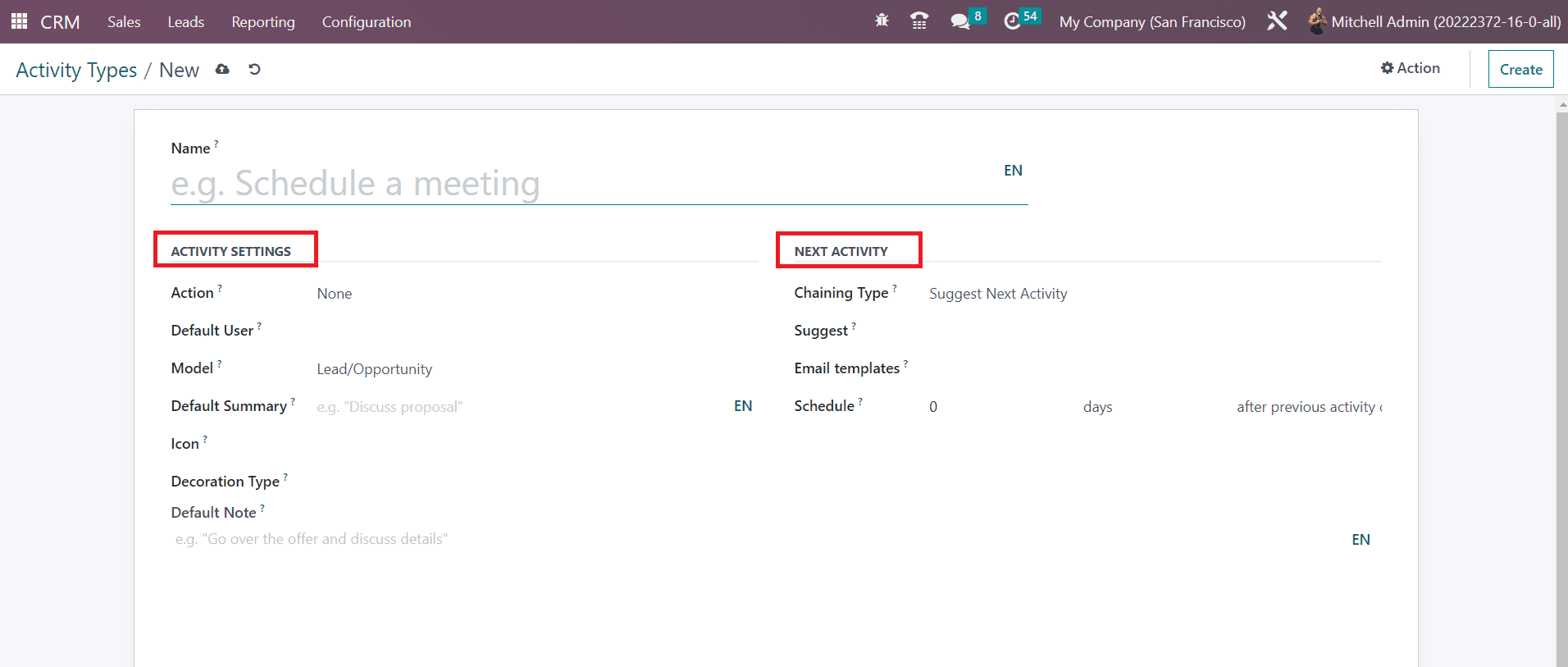
As you can see in the screenshot above, the already configured activity types can be observed on this platform along with the details of the **Name, Default Summary, Planned In, Type, Model,** and **Icon**. Now, let’s take a look at the creation of a new Activity Type on this platform. For this, you are allowed to click on the **Create** button. In the new activity type creation window, first, you can mention the **Name** of the activity in the given space.
Once you mention the name of the activity, you can select suitable **Action** from the given list. Actions may trigger specific behavior like opening a calendar view or automatically mark as done when a document is uploaded. You can set **Action** as Upload Document, Phone Call, Meeting, Reminder, Request Signature, Tax Report, or None. Mention the **Default User** of this activity type and **Model** in the corresponding fields. By mentioning the **Model,** this activity type will be specific for the mentioned model only and not available when managing activities for other models. In the **Default Summary** field, you can specify a few words about the activity and it will be set as the default summary of this activity type. The **Icon, Decoration Type,** and **Default** Note regarding the activity type can be mentioned in the respective fields.
While defining a new activity type, you will get an additional tab to mention the details regarding the next activity.
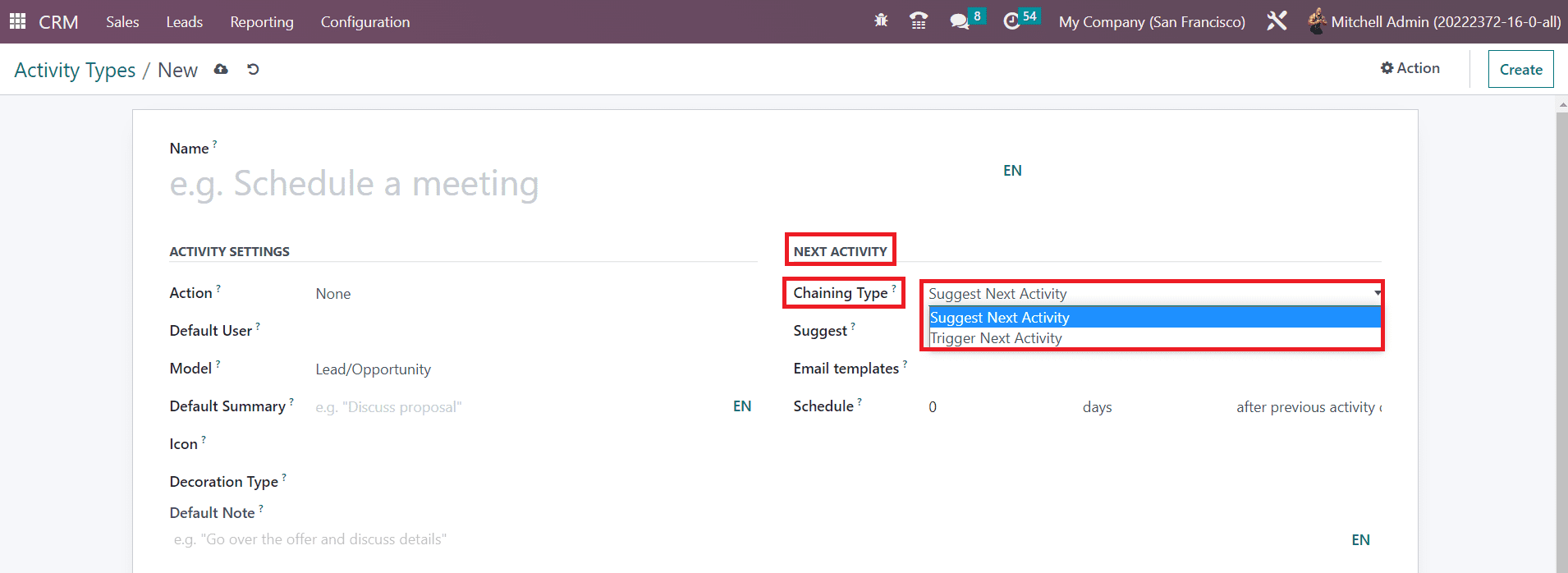
Under the **Next Activity** tab, you can set the **Chaining Type** action as Suggest Next Activity or Trigger Next Activity. By selecting the **Suggest Next Activity** option, you will get a field to mention the next activity as a suggestion. By doing so, Odoo will suggest the mentioned activity once the current one is marked as done. In the case of **Trigger Next Activity,** you can mention the next activity in the **Trigger** field. Once the current activity is done, Odoo will automatically trigger the next activity. In the **Email Template** field, you can add email templates that can be used to send emails to the concerned customers once this activity is scheduled with them. You can plan the action deadline in the Schedule field. Here, you can specify the number of days/weeks/months before executing this activity. By following these steps, you can effortlessly create new activity types in Odoo.
Now, let’s discuss the creation of new stages in the Odoo CRM pipeline.